Search This Blog

Showing posts with label Hinduism. Show all posts

Monday, September 13, 2010

Sandhi Ganesha

Yesterday was Lord Ganesha (Elephant God in Hinduism)'s day. In India, Ganesha is also known as a knowledge provider. He is purported to have written the Mahabharata under Saint Vyasa's direction.


As kids, it was absolutely crucial for us to worship Ganesha before any exam and most importantly Mathematics (not really sure why). The more devout, such as those who desperately need to pass the exam, would break anywhere from 1 to 108 coconuts (Ganesha's favorite) depending on the strength of their hand and wallet.

Unlike most Gods, it is never too difficult to find a Ganesha idol for worship in India - especially South India. There is pretty much an unwritten rule that if there is a 'T' junction, there MUST be a small Ganesha statue in that corner facing the street. In most cases, the house forming the broader side of the T ensures this. Some such Ganeshas tend to become more popular and eventually transform into a bigger shrine with proper worship. There used to be one on the way to school which I used to visit regularly. I don't know if it helped me study better, but it at least improved my confidence!

The Sanskrit word for junction is 'sandhi'. While sandhis refer to street junctions, they also refer to conjunctions within the language such as one that is formed by combining two words together.

While English does not have too many sandhis (may with the exception of I'd, We'd, aren't, etc.), I believe the underlying Latin does use it liberally, giving rise to many English terms. In Sanskrit, sandhis are used all over the place - for poetic, aesthetic, and probably egoistic reasons as well (for the poet to show his language prowess).

The downside with sandhis in Sanskrit is that depending on how the word is split by the reader, it can give a completely different meaning, which has led to a number of interpretations for almost every Sanskrit text ever created!

My grandfather used to give us a very hilarious example to highlight the importance of understanding the rules of splitting the terms to get the right meaning, and interestingly, it involves a verse praising Ganesha, the king of sandhis.

गजाननं भूतगणादि सेवितं कपित्व जम्बू फलसारभक्षितं ।
उमासुतं शोकविनासकारणं नमामि विघ्नेश्वर पाद पङ्कजं ॥
It translates as follows:
GajAnanam: O Elephant Lord
Bhootaganaathi Sevitham: Worshipped by the disciples of Shiva (bhoota ganas)
Kapitva Jambu PalasAra Bhakshitam: Likes fruits such as Elephant Apple (Kapit) and Black Plum (Jambul)
Umasutam: Is with Uma (Parvati) - wife of Shiva and mother of Ganesha
Shoka vinAsha kAranam: Reason for destroying all sadness for his devotees
Namami vigneshwara pAda pankajam: I surrender to your feet soft as lotus petals

Now, my grandfather's version is slightly different - the words are the same but they are just split differently

गजानानाम्बू  धगनादी सेवितं
कपित्वजम्बू पलासराबक्षितम
उमासु तमसो कविनाशाकारानाम
नमामि विग्नेश्वर पाद पंकजम

The translation now becomes this:
gajAnanambu: One who wears an elephant flower (bu -> phoo -> flower in Tamil)
daganAdi sevitam: Burns all those who worship him
kapitva jambu: Jumps like a monkey (kapi = monkey)
palasAra bakshitam: Devours all snacks given to him
umAsu: Brought bad name to Uma (Parvati)
tamSo: (I forgot what this one was - nothing pleasant I can assure you!)
kavinAshakAranam: Responsible for the demise of all poets who sing his praise
namami vigneshwara pAda pankajam: I worship one with such qualities!

Same words, but completely different meaning! It goes to show the importance of learning something properly and understanding the intended meaning and not a screwed up interpretation - something current religious scholars who (mis)interpret the original intention of various religious texts without putting it in context need to desperately learn!

Hope Lord Ganesha gives them such strength :)

Monday, November 02, 2009

A better definition of Learning

Webster and Oxford define learning as "knowledge or skill acquired by instruction or study". Most of our lives are governed by this definition - from pre-school all the way to adulthood, including certifications. While this is a decent definition, it does not exactly cover all aspects of learning, does it? How about learning by mistakes? How about the 'Eureka!' moments that you go through when you are in the bath tub? How about learning from others' learning?

We see glimpses of these types of learning either embedded in the generic definition of learning or as an addendum to the 'taught' learning process, such as team discussions typically done in business schools. However, due to the generally accepted notion of learning, not much emphasis is given on these other forms. This can be an issue because we tend to lose significant opportunities to learn in our child and adulthood by focusing only on rote learning and not the other options of learning.

Can we do better? Yes, we can. In fact, we don't have to look far. A much more precise definition of learning has been given in the Sanskrit literature, which amazed me when I first came across it as part of Prof. B. Mahadevan in his article on Sanskrit and Business Management that I blogged about earlier. Here's the verse, and my visual depiction of the verse.

In English,

Aachaaryaat paadamaadatthe paadam sishyah svamedhayaa
Paadam sabrahmachaaribyo paadam kaalakramena cha

Sounds Sanskrit? Here's the breakdown (thanks to my brother, who can actually understand as opposed to just reading it!):

aacharyaat - from the guru
paadam - quarter
aadatte - receives
paadam - quarter
shishya: - student
sva medhayaa - by his own intelligence
paadam - quarter
sabrahmachaaribhi: - from his fellow students
paadam - quarter
kaala kramena - by time
ca - and

Essentially, learning is defined as one quarter teaching, one quarter self study, one quarter group study, and one quarter done over time. Can you be more precise?!

Taught
If you think a bit, you can see the depth of the meaning that is described so beautifully here. You learn from your teacher. This is the one that is done formally through the education system.

Self-Study
Then you reflect on the thoughts be they coming from the teacher, of your own volition, or from your surroundings. A classic example of this would be the 'Eureka!' moment that Aristotle had when he was sitting in his bath tub. How many times have you had such moments when you were driving or when you were on the shower? Many a times, I have found myself honing my ideas or thoughts better, be it related to my work or personal life when I just sit back and think about it. Maybe emphasis on meditation in Sanskrit was to promote this form of learning.

Group Study
You also learn from your peers, a concept established successfully by the 'Hole in the wall' experiment by Sugata Mitra. While we do this in school most times, there is sadly very little emphasis on the power of such learning. Normally, we are encouraged to do things by ourselves than as a group. On the contrary, you can see most business schools put a lot more emphasis on group discussions, potentially to unlock this form of learning. I remember my college days where a bunch of my friends used to study through the night (in the middle of watching a variety of serials that come late night ;)) weeks before the final exam. It helped me personally and I believe the group in general as well (we all got really good grades!).

Over Time
Lastly, there is the process of learning over time, either by way of experience or by way of history. As the famous quote goes, "those who do not learn from history are condemned to repeat it" - true words, embedded in this stanza ages ago. Most projects take some time to 'learn' from successes or failures of previous projects.

Years back, computer scientist Peter Naur wrote a paper titled "Programming as theory building" - one of the best articles I've read, and something that holds true even today, even in completely different contexts. Essentially, he argues 'swappable' resources are not a great idea. His argument is that each programmer builds a mental model or theory about his program during the course of development. In most cases, this model is seldom documented or communicated with other resources (primarily due to the difficulty in expressing the model in words). As a result, when the programmer leaves, the theory leaves with him, essentially resulting in another programmer building another theory (or rarely, the same theory) from scratch. How many times have you looked at a piece of code and wondered what the heck the programmer was thinking?!

I found this concept in a completely different setting, in a book called The art of game design by Jesse Schell. In the book, the author describes a concept called Flow Channel identified by psychologist Mihaly Csikszentmihalyi (and they say my name is hard to pronounce!), which is the basis for levels in a game - more on this in another blog.

So, in effect, our education system is really tapping into only 25% of the whole learning process. Imagine how it would be to tap into the whole process?! I wonder when we will learn that the learning provided by our learned ancestors would facilitate better learning for the future generations.

Sunday, October 18, 2009

Management in Sanskrit literature

A few weeks back my brother sent me a lecture delivered by Prof. B. Mahadevan who works at IIM Bangalore. The topic is "What constitutes good management - Lessons from ancient Sanskrit scriptures" delivered as part of the "Sanskrit and Science" series. The first couple of paragraphs unfortunately a bit dry (probably due to the transcription of a lecture) and hence I promptly shelved it for a later time. While on a flight today, I came across the article that I had almost forgotten, and I am glad I took the time to go beyond the first page.
In the lecture, Mahadevan lists five primary qualities for a person pursuing management skills, namely
  1. Ability to visualize the big picture
  2. Systematic approach to problem solving
  3. Attitude towards learning as a way of life
  4. Managing short-term vs long-term conflicts and
  5. Having leadership traits
I think this is a fairly neat and relatively concise way to look at management skills. He goes further to explain how each of these concepts is explained in various Sanskrit scriptures and how they are relevant even in this day and age. Here is a quick rundown.

Ability to visualize the big picture

One of the striking quality of Hindu scriptures is the concept of providing multiple viewpoints to a single idea, thereby providing an option for the reader to pick and choose the idea he sees close to his mental picture, while still achieving the same goal. There are various philosophies within the Hindu system that talk about salvation, although the path taken is completely different. It is interesting that the ancestors have thought of these myriad possibilities and listed them rather than emphasizing on a single idea.

In one classic example, the vishwarupa (literally magnanimous form) of Lord Krishna in Mahabharata is described as "the light shining from a thousand sunrises", an expression that Robert Oppenheimer quoted when witnessing the first atom bomb blast. There are numerous other examples where the vastness of time and space are explored in detail while sitting in a corner of this world.

Such "big picture" thinking is now deemed as an important quality for a good manager.

Systematic approach to problem solving

Mathematics has been embedded in various Sanskrit literatures. Not only have they thought big, they have also taken pains to categorize the vastness and also provide a proper system to calibrate it. Even more amazingly, in Rig Veda, one of the most ancient Sanskrit scriptures, the speed of light has been calculated as 3.020263x10^8 m/s, an extremely close approximation of the current definition!

As Mr. Mahadevan surmises, this systematic approach seems to stem from the spirit of inquiry that is encouraged within the scriptures themselves. Scriptures such as Katha Upanishad and Prashna Upanishad are written in a question-answer format, that promote this idea strongly.
As an example, Mr. Mahadevan quotes a stanza from Lilavati by Bhaskaracharya, where proper nomenclature is given for number systems ranging from 10^0 to 10^17. Remember, this was written hundreds of years ago!

Similarly, in Bhagavatam, another popular Sanskrit scripture, nomenclature has been given for time ranging from 10^-6 seconds to 10^17 years.

Learning as a way of life

Sanskrit and pretty much everything else in the past was taught in Gurukulams, literally meaning the teacher's residence. In the past, learning happened by way of apprenticeship, wherein the students will stay at the teacher's place for a prolonged period of time and learn various skills.

Mr. Mahadevan quotes an amazing verse that defines the idea of learning: Learning is one fourth taught by teacher, one fourth learnt by self-reflection and thinking, one fourth by group study, and one fourth is learnt over time.

This, I feel, is an excellent and probably a very accurate way to think about how we learn. Personally, when I was in college, I used to learn part by reading by myself and part by doing 'group study' with my friends, which I felt greatly enhanced by learning as well. A similar conclusion was reached by Sugata Mitra in his experiment "Hole in the wall" (the idea behind the book Q&A by Vikas Swarup, which was the inspiration for the Oscar winning movie, Slumdog Millionaire). I hope to expand on this in another blog post.

Understanding that learning is something that happens over time and not just in an instant provides a level of humility and also alerts one to be constantly on the lookout for new knowledge.

Managing short-term vs. long-term conflicts

As Mr. Mahadevan states, Hindu philosophy itself is one long conflict between short-term goals and long-term goals. The idea of living the current birth while reincarnating multiple births before reaching salvation provides a great analogy for this concept. The concept of karma accumulating over time and birth and the prospect of managing it well in this life to facilitate future ones is not dissimilar from a manager weighing in short-term gains to long-term gains.

Leadership traits

Finally, every manager needs to have some leadership qualities (which unfortunately, is lacking in most politicians today). As Mr. Mahadevan shows, Sanskrit scriptures explain the idea of leading by example and having an emotional balance in multiple places to highlight this idea.
Over the years, I have wondered why Indians (and Asians in general) tend to be more 'doers' than 'leaders'. While I have thought that it was mainly because of the submissive past (most Asian countries were colonies of the Western world), it looks like the root problem is more because of the educational system that is in place in these countries that focus more on rote learning instead of creativity. While the Western world seems to have rectified this error (after all, the current system is based on British learning system), they seem to now have erred too much towards creativity, thereby creating a void in analytical skills. It looks like what we need in our educational system is a right balance of the two.

So, if the ancient Sanskrit scriptures contain so much wisdom over a wide range of topics that are relevant even today, why aren't people, especially Indians who are close to it, look at them with vigor?

As Mr. Mahadevan states at the end, Sanskrit can nowadays be learnt in two phases of life - one as part of collegiate and graduate studies by students taking special interest in the subject, and two, as an adult who has established a secure future by other means. Since the Indian society largely favors careers oriented towards a secure job (such as IT, medicine, and engineering), it would be very hard for students to make Sanskrit literature as their career.

So, the only other and probably the most viable option is for professionals who have a secure job (the same IT, medicine, or engineering) to take up Sanskrit at least as a hobby and start learning so that they can unlock many more mysteries that it may hold.

On a side note, I have also wondered why the people who have provided so much wisdom preferred an oral mechanism of passing on the information through generations instead of a secure written mechanism. I have an idea why, and hopefully that'll be the topic for another blog!

In the meanwhile, I strongly encourage you to read Mr. Mahadevan's lecture, excusing the spelling mistakes at the end and relatively dry start. It's well worth your time. My only niggle is that the transcript does not explain the verses he quotes in more detail.

Tuesday, October 06, 2009

Maslow's hierarchy of needs and Yoga Chakras

A while back, I wrote how Darwin's theory of evolution seems to be codified within the ten avatars of Vishnu in Hindu scriptures long before Darwin was even born. The point was that we need to take a closer look at our respective ancient scriptures and texts with a more serious outlook without dismissing them outright as irrelevant.

Yesterday, I came across another instance where I think what the Western world had identified is something that has existed for ages - it's just that nobody bothered to take it seriously in modern times.

Maslow's hierarchy of needs

Case in point is Maslow's hierarchy of needs. I have come across the hierarchy a few times in popular science non-fiction books on psychology and brain function. Postulated by Abraham Maslow in 1943 after observing different types of people, it lists 5 types of human needs, stacked one atop the other. The theory is that one cannot move to the next level in the pyramid unless all the needs below it are satisfied. Here's a quick snapshot of the hierarchy.

For example, one does not worry about safety and morality when survival is at stake. Similarly love flourishes when one is secure. Finally, one tends to think about self-awareness only when the other needs are first taken care of.

Yoga Chakras
Maslow need not have wasted his time on research. The same concept, in an even more expanded form, is codified in the Hindu scriptures in the form of Yoga Chakras.

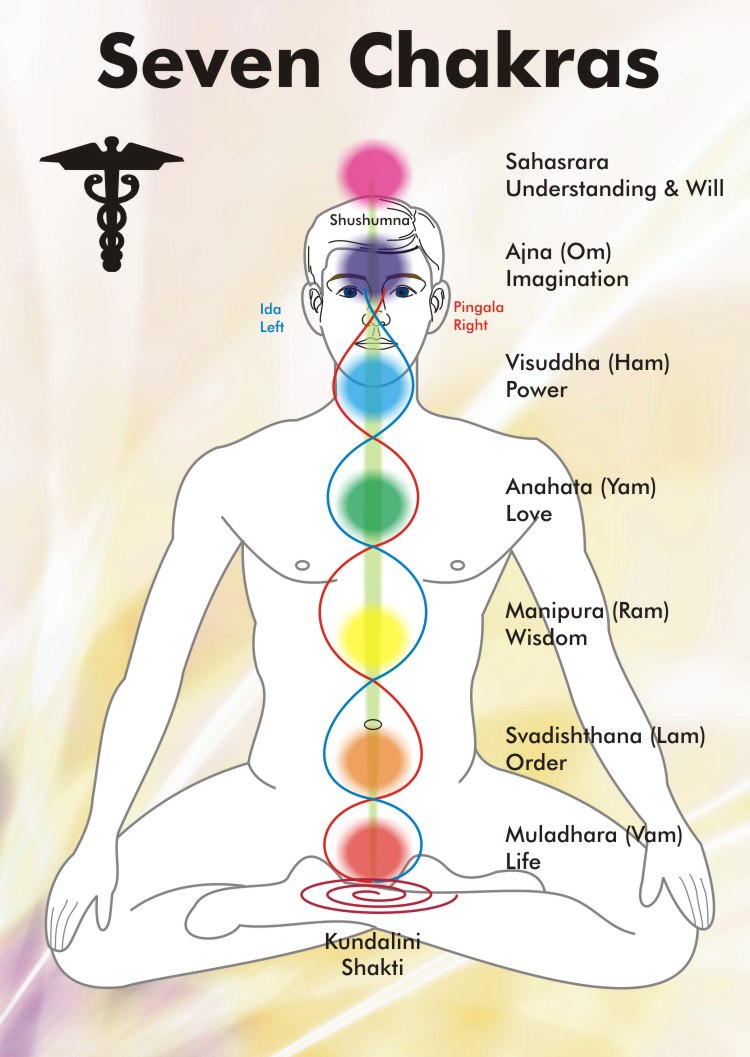
Chakras, as described in the Yoga Sutra (Sutra = Scripture) is embodiment of various forms of energy stored in a human body. The concept of chakra is mentioned in the Rig Veda, one of the most ancient Hindu scriptures, and were later made popular by the Sankhya philosophy (of which Buddhism has its roots). The scriptures state that a body needs to ensure that the energies are balanced at all times, failing which various forms of ailments (mental and physical) may arise. Channeling the energy properly (also described as channeling the 'chi' in Chinese spiritual texts) can help one attain enlightenment or freedom from this material world.

Now, how does this compare to Maslow's hierarchy? Let's first take a look at the chakras.

Each chakra is associated with certain qualities which represents the corresponding energies. They are
  1. Muladhara: Located at the end of the spinal cord, this deals with survival instinct.
  2. Svadhisthana: Located in the lower abdomen, this deals with feelings and sexuality.
  3. Manipura: Located near the stomach, this deals with self-power or basic intellect.
  4. Anahata: Located near the heart, this deals with love.
  5. Visuddha: Located near the throat, this deals with learning and expression.
  6. Anja: Located between the brows, this deals with self-awareness and insight.
  7. Sahasrara: Located at the top of the head, this deals with enlightenment or wisdom.
Looking at the two hierarchies side-by-side, you can see some amazing similarities:

Muladhara and Svadhisthana are related to Maslow's physiological needs.
Svadhisthana and Manipura are related to Maslow's Safety needs.
Anahata maps to Maslow's need for love and belonging.
Visuddha maps to Maslow's need for self-esteem.
Anja and to an extent Sahasrara maps to Maslow's self-actualization.

Unlike Maslow's needs, it does not stop there. Like most other aspects of Hindu literature, the chakra has multiple facets embodied in one simple codification. Here are two other facets to the chakra that are even more amazing.

Each of the chakras are located next to or are associated with a hormonal gland or organ in the body that has close correspondence to the activity described in the hierarchy.

Another explanation is that each chakra is associated with a light spectrum component, essentially spelling out the colors of the rainbow.

Apart from these, the chakra is also associated with a representation of the lotus flower, with each chakra having different number of petals. I am not sure what the numbers represent though, but am curious to find out. The overall chakra concept is also represented in the Kundalini form of yoga, which deals with channeling the energy through these chakras to achieve enlightenment.

I wonder how many other symbolisms are embedded in our ancient scriptures that we have since dismissed as heretic or irrelevant based on the bias and prejudice we have developed over the last few hundred years. I only hope that we have the sensibility to wipe the slate clean and look back with an open mind.

As the Zen philosopher Shinryu Suzuki said, "In a beginner's mind, there are many possibilities. In an expert's mind, there are few."

Sunday, August 23, 2009

Lord Ganesha and the Super Brain Yoga


Today is Ganesh Chaturthi - the birthday of 'elephant-God' Ganesha, worshipped by followers of the Hindu religion (myself being one of them). Hindu religious festivals are mostly based on the lunar calendar. This one is no different in that the festival is celebrated on the 4th day - (sukla) chaturthi in Sanskrit is 4th day of the (waxing) moon - of the Bhadrapada masa (which is the 6th month in the lunar calendar), which roughly comes mid-August - mid-September in the Julian calendar.

While I tend to be religiously neutral, I cannot but help appreciate and admire the various intricacies and profundity embedded in various religions. Hinduism, probably due to its age, contains numerous nuggets that, when looked with a skeptical (but not cynical) eye, holds a lot of treasures that are relevant even today. It is sad that such important lessons are lost today because most of these symbolisms are taken literally.

Ganesh Chaturthi is one such festival in the Hindu religion that holds a number of interesting symbolisms that are relevant today. Here are a few to my knowledge:

Eco-worshipping
Ancient Indian practices have been amazingly eco-friendly (possibly because plastic hadn't been invented yet!) In temples, food used to be served in containers made of leaf and other plant products, which are biodegradable. In Ganesh Chaturthi, eco-friendliness is taken to another level, where Ganesha being worshiped is made of clay and then dissolved in water once the festival is over, leaving no harmful residue.

The other beauty of this is that anyone with a little bit of clay can create the image quickly and worship Ganesha (Ganesha, by the way, is one of the easiest Gods to draw or sculpt!). This notion brings a level of equality that is seldom seen in other festivals or practices.

Unfortunately, over the years, both these symbolisms seem to have been lost or at least diluted. Nowadays, the size of Ganesha idol constructed and worshiped during the festival has become a status symbol, especially with political parties vying to have a big statue to show their party's affinity to the God. The eco-friendliness has also lost its meaning over the years, with Ganesha being painted in potentially harmful paints that may be water soluble, but not necessarily bio-degradable.

Super brain yoga
Recently, one of my friends forwarded a video in YouTube called Super Brain Yoga. Supposedly based on the works of Chinese accupuncturist Choa Kok Sui, the video shows how a certain action can potentially increase memory and brain power.

What is interesting is that this pose (or exercise), has been associated with Ganesha for hundreds of years. We have been taught as children to perform this 'exercise' a minimum of 9 times whenever we pray to Ganesha. Alternately, this has also been associated with Indian schools as a form of punishment!

While it is sad that neither the video nor Sui's website mentions Ganesha, there are some stronger symbolisms that I could not help but notice.

Ganesha has been associated with education in Hinduism. Moreover, Ganesha has an elephant form. Elephants, as we know, have an extremely strong memory. While I am not jumping to conclusions here, it is interesting that an exercise form supposedly proven to increase brain/memory power is associated with a God who is associated with education/learning and is symbolized as an animal that has strong memory!

I wonder how many other such interesting aspects are there embedded in every religion that has since been diluted or outright dismissed as superstition or blind-faith.

Saturday, July 25, 2009

If only we learned from our past - Vishnu and Darwin

There is a famous quite by a Spanish philosopher George Santayana - "Those who do not learn from history are doomed to repeat it" - very true indeed. We humans seem to have a penchant to not learn from our past experiences, and more importantly from those of others - be it our daily lives, or our civilization. In most cases, we tend to ignore some very interesting thoughts that were penned by our ancestors, discounting them as ancient, irrelevant, or useless.

A prime example is a concept that is engrained in the Hindu religion, called the 'Dasavataram of Vishnu' or '10 avatars of Vishnu'. Vishnu, in Hindu philosophy is the God of protection and is one of the three primary deities (trimurthis) - Brahma (Creator), Vishnu (Protector), and Siva (Destroyer).

The thought is that Vishnu, being responsible for protecting beings in Earth, takes an appropriate form (avatar) once a while (usually once a 'yuga' or epoch) to provide guidance by example. The 10 avatars of Vishnu has been documented heavily in the Hindu scripts - I don't know how far it dates back, but have at least seen them in sculptures that age back to 1000AD and potentially beyond.

What is most interesting to note is that the 10 avatars of Vishnu coincide with Darwin's concept of evolution - ages before Darwin came up with the theory. I was first made aware of the connection when my brother wrote an article on it a few years back. Here are the 10 avatars, their symbolism, and my interpretation of the symbolism.

Source: http://commons.wikimedia.org/wiki/File:Dasavatar,_19th_century.jpg

1. Matsya
Fish
Aquatic (first species to evolve on earth)

2. Kurma
Tortoise
Amphibian (movement from the ocean to the land)

3. Varaha
Boar
Land creature (proper evolved mammal on land)

4. Narasimha
Half man, Half lion
A combination of man and beast (symbolises the transition from animal to human)

5. Vamana
Child
Child (Starting signs of intelligence and thought)

6. Parasurama
Plough-wielding man
Farmer (Starting of agricultural evolution and use of Iron)

7. Rama
King (with bow and arrow)
Fully evolved human (Use of bow and arrows, Evolution of governance)

8. Krishna
King (and peacemaker)
War and Peace (Evolution of politics)

9. Buddha
Saint
Peace (Establishment of a peaceful system. Emphasis on current life instead of moksha)

10. Kalki
Man on horse
??? (supposed to take form by end of this current epoch - in some sense signaling apocalypse and facilitating humans beyond the apocalypse)

As with any interpretation, you might say that I am fitting a theory into facts than the other way around, but I feel that the coincidence is just too strong to dismiss it as mythology. I wonder how many other such concepts are hidden in the earlier scriptures that we have discounted as mythology or paganism.

Also of interesting note is that out of the 10 avatars, only 3 are exclusively worshipped (Rama, Krishna, and Buddha - all of them in the most recent epochs) and 2 in some areas of India (Narasimha and Varaha), while the remaining 5 are more of historic interest.