Search This Blog

Showing posts with label india. Show all posts

Sunday, August 15, 2010

Independence from our actions

Today is India's day of independence from the British rule in 1947, paving way for India to become the largest democracy in the world. News sites and TV channels in India have been running 'specials' about the Independence a few days before things get back to status quo. While India has achieved independence from external influences, I don't think we can achieve full independence till we are free of our own actions and behaviors. Let me explain.

Yesterday, I attended a function in a temple here in USA. The preparation for the function was excellent complete with a very artistically done rangoli (an art made of colored powder, typically made of rice flour, turmeric, or other such ingredients). As with many other temples, photography and videography using any device is prohibited in the main area and numerous warning signs/requests are posted all around.

Even with all this, I still saw one person (at least) who was busy taking pictures of both the art as well as the rest of the temple (including the main deity). While she did stop taking the pictures when the signs (that were quite obvious) were pointed out to her, it made me wonder why she did it in the first place.

The argument I can imagine coming from her is - "The art is very beautiful. I may not be coming here any time soon. So I want to capture it for my personal reference" - the argument is not unlike one made when downloading a song from a file share site. "What is the harm if I do something just for my own sake?"

In the book Diffusion of Innovations, the author refers to this argument as the "Tragedy of Commons", attributed to Garrett Hardin. The core of the dilemma is "Each individual pursuing a rational course of behavior that ironically drives the entire system to disaster", which to me, is what is ailing India at this point - the notion that our small actions will not have an impact on the greater system. Such behavior is obvious in various strata of life - be it giving a small bribe to the traffic cop when making an illegal move, not adhering to the posted rules, or improperly disposing trash, and so on. While it is true that the tragedy of commons is a complex solution that involves both system-level corrective actions as well as individual, there are some steps that can be taken without resorting to a system blame.

To me, when someone violates simple rules that can otherwise be observed without significant ramnifications for purely selfish reasons, they lose all rights to complain about the larger system, since they are effectively contributing to the larger system's downfall in their own capacity. Malcolm Gladwell in his book Tipping Point, refers to the broken windows theory - if a window is broken in a house and not repaired, it slowly propagates a level of carelessness or apathy within the system that eventually makes the whole neighborhood look rundown. This is especially very visible in India in the form of street litter, to take one example.

What it seems is required is not just freedom from external influences, but really freedom from our own internal actions - be it adhering to a "No Photography" sign in a temple or doing what it takes to get our work done without succumbing to bribery. The "Tragedy of Commons" can also be turned around in its head to become "Wisdom of Crowds" - if each of us adhere to rules as much as we can (and as much as it makes sense), we can help make the system better - eventually.

As they say, "charity begins at home".

Independence is about hope - hope for a better life and a better world - let's hope that we achieve independence, not just from external actions, but also those of our own that are not desirable.

Sunday, May 23, 2010

Mobile companies and their analogous countries

Sometimes when a problem is too big or too abstract to grasp, we tend to equate it to something we can grasp better. We call it an analogy. Dictionary.com gives this definition:
A similarity between like features of two things, on which a comparison may be based: the analogy between the heart and a pump.
There is also a different application to an analogy. You can use it to compare a new concept to a mature concept to get a sense of how the new idea might mature in future. While this of course is not perfect, it is a reasonable approximation.

Recently, I came across an article in Engadget called Is Android fragmented or is this the new rate of innovation?

The article led me to think beyond just Android and more about the mobile market in general, and even the companies that are responsible for the primary mobile platforms. I saw some interesting similarities between these platforms and how they are modeled and some of the leading countries in the world and how they operate. I felt it was a reasonable assumption as, after all, we are seeing the mobile platform spawn the world effortlessly. So, here's my analogy of the mobile platforms (and the companies) to some of the countries of the world.

iPhone / Apple : China
The first one of course, is the most popular mobile platform at the moment, the iPhone. 


The success of iPhone as come about due to the following factors.
  • Hundreds of applications at a relatively cheap price point
  • One single platform and phone model (with minor variations)
  • Tight grip over the user and developer base
  • Tight control / censorship over how information is disseminated over its platform
While you might argue that its design innovation is what made it the leader in the space, I would argue that the factors above are what has made it sustainable beyond the initial shock and awe. As you can see, the tenets are not too dissimilar from how China operates as well.

While China is the envy of the world and is fast gaining economic power, there is also resentment about the practices it has used to get there. The point of this blog is not to argue whether such practices are ethical or not - it is up to the larger population to figure out. Rather, to me, what is striking is the similarity in itself.

Interestingly, like China, while people grudgingly complain about the non-openness of the platform and authoritarian practices, they nevertheless go ahead and buy iPhones. 

Android / Google : USA
Google is fast becoming a major competitor in the mobile space. Already a world leader in the search space, the Android OS has positioned Google well to compete in the mobile area, which to Google, is another feed for its search domination.


Android (and hence, Google) has the following features.
  • It is based on a 'relatively' open platform 
  • Everyone is welcome to develop in the modified Java system, but the platform retains control over its future
  • It has an 'open' market although with a slant towards it's own powers (search)
  • It attempts to corral the rest of the industry towards standardization
  • The company promises to do 'no evil' (but may not be acting on it or perceived to be acting on it)
A lot of the fundamental principles to me seem to resonate with how the US Government operates. While in general, it tries to do more good than harm, there is general skepticism that it maybe doing it the other way around. People are cautiously optimistic about the new platform.

RIM / Blackberry : Canada
Research In Motion's Blackberry OS has become the de facto standard in business mobile usage. In that aspect, maybe it is not that similar to Canada, however there do seem to be some similarities.


  • The platform is loosely based on a more standardized platform (J2ME)
  • Even though the platform is quite open, it is still not as popular as it was expected to be
  • It is happy to be in its own space, without trying to influence others
I am always surprised at how the platform has really not tried to expand to other markets, even after other players such as iPhone have come in and at the same time also maintain its hold on what it does best. May be they follow the words of  Jim Collins in his book Good to Great to the dot, which is not to say that it's a bad thing.

Microsoft / Windows Mobile : European Union
The article I had mentioned earlier differentiates Windows and Android in the way they see the device and software partners. Since the beginning, Microsoft has always thrived on a license-and-partner relationship, which has worked to its advantage over the years.


Windows Platform has the following characteristics.
  • It works on a partnership model. Everyone pays a license to develop on the platform
  • The platform heeds to the needs of the partners and waits till everyone is on board
  • The overall fee structure is more expensive compared to other similar platforms
  • Change is hard to make and it takes a while to happen as well
It's also ironic that Windows platform is similar to EU, given its recent problems with EU! However, the partner model (and problems thereof) does seem to resonate well.

Oracle / J2ME : India
Finally, we have the Operating System that most platforms other than those mentioned above, are based on - the Java Micro Edition. I would potentially put Symbian in the same category as well.


Let us look at the defining characteristics and the similarities.
  • It's the most open platform compared to all others
  • It tries to please everyone and sometimes ends up pleasing no one
  • By trying to find a common minimum that will satisfy all devices, it tends to fall short of user expectations, leading users to create their own variant platforms
  • Being a 'democratic' system, it has little control over the devices where it is used, leading to significant fragmentation, which in turn, compounds the problem of trying to find a common minimum.
  • Even though it is a credible and viable platform, it is outdated and is fast losing its market relevance
To me, the J2ME platform's similarity to India is probably as striking as Apple's similarity to China. Interestingly enough, while both are hailed as leaders in their own way (largest democracy vs economic super power), they have their own differences.

While it may take a while for the countries to play out their roles, may be it will be interesting to see how the market reaction is to these mobile platforms, which in turn, may give a good indication of how the world will shape up - and I am not sure if the results we may see in future is something we may like to see ;)

Sunday, March 28, 2010

What (Indian) Vegetarian are you?

This is a question I have been asked quite often. My colleagues often get confused about the vegetarianism of Indians, as there does not seem to be a common pattern or even a strict definition. This is a reasonable confusion, as there indeed, is no single answer.

Typically, food preferences are associated with religion. For example, Muslims do not eat pork (pig) as it is forbidden by the religion and also eat only halal foods. Many Christians do not eat meat during the season of Lent. Similar restrictions apply for Jews in terms of kosher foods.

For people who follow Hinduism, the predominant religion in India, the generally accepted rule is that they do not eat beef (cow meat), as cows are considered sacred. This is also reflected in airline food preferences, where "Hindu" food means "no beef" (can include other meats). However, this is not exactly true either.

As a practicing Hindu as well as having been born and raised in India, hopefully I can provide a better answer to this vexing question to many Westerners, particularly those involved in the IT profession, as they end up brushing shoulders with Indians mostly and also have to put up with their meal preferences during lunch and dinner!

Hindu Vegetarianism

Unlike many religions, to my knowledge, in Hinduism, codes of conduct are not strictly enforced. The religion, as I perceive it, is more democratic, and lets the follower decide how to follow the religion. The codes tend to be more of 'best practices' than commandments. As a result, enforcement of the religious codes are often done by means of social and economic pressure rather than the religion itself. Due to this, the dietary composition of a Hindu is more driven by where he lives rather than what the religion says. Thus, you can find that Hindus in coastal regions such as West Bengal and on the east and west coasts of Southern India consider seafood as a staple food while also being devout Hindus. In the more interior regions, chicken and at times lamb is also eaten as a staple food by Hindus.

Theory of Emotional Detachment

When asked what type of food he eats, one of my colleagues used to say "anything that does not have eyes". This is a close enough approximation for an Indian Vegetarian. I have a slightly more elaborate theory about vegetarianism, which I feel provides a better model for vegetarianism in general and Indian vegetarianism in particular. The theory essentially is that a person's level of vegetarianism depends on the level of emotional attachment one has with what he eats. In simpler terms, the more something looks or feels like you or emotionally attached to you, the less you are likely to eat it.

So, let's put this theory to test. Based on the theory, I propose the following scale of vegetarianism.


It's simple at the start - we don't eat humans (cannibalism) because they look like us the most and also are of the same genre. Up next, we have the exotic animals (koalas, panda bears, insects), weird body parts (brain, reproductive organs, eyes, nose), and animals that we are fond of or feel relative empathy towards (dogs, cats, chimpanzees).

Things start getting a little interesting from there on. The next level is consuming most kinds of red meat, typically pigs, cows, lamb, and versions thereof. This is probably the most prevalent diet throughout the world. As we saw before there are certain restrictions here based on religion, but in general red meat is the common theme. Such animals are considered eatable, as they have been used for generations for consumption, and hence we are emotionally detached with them. The restrictions at this level reflects the level of emotional attachment as well. Pigs are considered bad as their 'filthy' habitat is considered as reflective of those who would eat them as well. Similar theory is also reflected in parts within Hinduism, where scriptures say "you are what you eat" and hence you attain the qualities of the animals that you end up eating. In addition, cows are considered taboo, as in ancient India, they were used for multitude of purposes (farming, dairy, and general labor) and so the emotional attachment was high.

In the next stage are the "white meat" eaters, who do not eat red meat, but are fine with white meat - which includes many birds - chicken, ostrich, and quail to name a few. The emotional detachment with birds tend to be a lot higher as well, since they are not typically tamed or befriended (raising chickens for eggs does not count!). They also look a lot less like us and the lack of red meat is also visually less emotional to the eaters.

The next stage of meat eating is with seafood. Once again, the emotional detachment is extremely low, as sea creatures look a lot less like us. Moreover, for generations, sea creatures have been considered as staple food along coastal regions and hence have not been considered as 'true meat'. In India, however, nowadays the aversion is more due to the sight and smell than by religious preference.

After this point, we get into the more vegetable-based space. The two stages here - "Vegetarian Lacto-Ovo" and "Vegetarian Lacto", covers what I would call as the "Indian Vegetarian", a space where I fall under. In these stages, all forms of meat (aka "those that have eyes") are not eaten, while dairy products (cheese, milk, yogurt, etc.) are considered acceptable and in some cases, even eggs (technically they don't have eyes!). There are two interesting twists here - the "cake lover" - which most of my more "strict vegetarian" friends are. They do not prefer to eat eggs - scrambled, poached, or even egg strands in a Chinese Fried Rice. However, they are fine with eating cake, even though the cakes contain eggs. I believe the emotional detachment again comes into play - as long as they do not 'see' the egg in its close-to-raw form, they are fine, such as in the case of a cake. This could also be attributed to the social aspect. Most Indians are more Westernized and birthdays are celebrated with cakes. So, we are raised with a tolerance towards cakes and hence, it's not considered as 'meat'. Same goes even for fish oil that most moms give to kids when they are young for the essential Omega-3 fatty acids that are found lacking in a typical vegetarian meal.

Another twist is the "Vegetarian Jain". Jainism is a distinct religion primarily practiced in the western parts of India (most of Gujarat and areas around Mumbai) that has its origins around the time of Buddhism. Jains believe in non-violence and hence do not eat anything that is considered as harmful to other creatures. As a result, they avoid root vegetables (can potentially kill animals under the ground while plucking the vegetables), honey, and similar products. Some people who are more strict also do not eat stale food and hence avoid any fermented product more than a day old. Interestingly however, milk is considered acceptable. My guess is that taking the milk from a cow technically does not harm the cow and hence it is fine, as long as the calf is given its due share. This is probably why even in the more general Indian vegetarianism, milk is considered as vegetarian.

Inclusion of milk and at times eggs are probably the most importance differences between a vegan as it is defined in the Western world, and vegetarian, as it is defined in India. That's also why it irks me to no end whenever I end up getting tasteless vegan stuff in Continental Airlines when I request a "Vegetarian" meal (sometimes the "Asian Vegetarian" meal, which is essentially "Vegetarian Lacto", is not given as an option).

So, hopefully this gives you an idea of the nuances in vegetarianism, and helps better understand the plight of your fellow colleagues!

Saturday, March 20, 2010

'Recycling' ideas from developed to developing nations

Over the last few years, the 'green' movement has picked up a lot of momentum. If you haven't heard of it already, which is almost impossible, 'going green' is essentially means being environmentally friendly. While it initially used to be confined to recycling your Coke cans, it has now expanded to almost all walks of life. And being a capitalist nation, USA (and pretty much most other developed nations) are cashing in on the new-found concept. Companies are competing with each other in trying to be 'greener' than the other, proclaiming support to green movements, funding challenges to come up with the 'greenest' idea and so on.

But this is not a new idea. In fact, it is literally going back to the past. Pretty much all countries started being green, became non-green due to the industrial revolution, which demanded mass production of pretty much everything with little regard to the impact it could have on the natural resources, and then are now trying to be green again, although with a higher price tag.

Having born and brought up in India, a 'developing' nation, it is kind of ironic to see the new green competition. I lived through the times when things were in fact as green as they could be, witnessed the systematic destruction of the same due to 'modernization', and having come to a 'modern' world, seeing the good ol' ways being promoted as the next 'modern' thing to do at a much higher price point!

To prove my point, let me give you some examples.

Cleaning Supplies

Probably the most obvious and the most immediate idea that is being recycled from the 'developing' world to the 'developed' world is that of cleaning supplies.

When I was young, my mom used cleaning products that were pretty much based on Grandma's recipes - ones that used all sorts of natural ingredients like lemon, coconut fibers, etc. As time progressed, the more chemical based solutions such as bleach and phenyl became the norm and those who did not conform to the new standards were shunned, ostracized, and termed as 'ancient'. Ironically, now I see Chlorox and 3M coming up with a whole bunch of 'green' products that use - guess what - the bloody same ingredients that the 'ancients' used to use in the past.


Source: http://www.ecosherpa.com/green-home/chlorox-green-cleaning-products/


Source: http://www.3m.com/us/home_leisure/scotchbrite/greenerclean/

Sadly, in the process, the chemical products have become the norm in the developing world causing harm, which is further complicated by the fact that the population of the developing world is much more than the developed one. I am sure the concept will recycle back to them, but I wonder if it will be a little too late.

Bagging

The next obvious section is that of bagging.

When I was a kid, my mom used to give me a cloth sling bag, which was primarily used for groceries. Optionally, we had a variety of other cloth bags or worst, plastic baskets. There were no department stores as we see today, but rather, a local grocer. The grocer would pretty much have everything in bulk and would measure the ones we need, wrap it up in newspaper, and tie it with a jute string (natural fiber, made of coconut tree, I think). Once I come back, my mom would unwrap everything and put them in respective jars.


Source: http://trak.in/Tags/Business/mall-culture/

As times changed, department stores started emerging. The biggest advantage they had against the grocers (which as a much more personalized service as we would shop with one grocer for decades) was that it was reliable (no skimping on weight or suspicion of adulteration) and it came individually wrapped in plastic, which was more convenient for storage. Eventually, even the grocers started adopting the plastic wrapping concept except for a few products, combined with an extravagant use of plastic bags (thankfully constrained by the general stinginess of the grocers to give too many plastic bags).


Source: http://www.indiansamuraimovie.com/visual.html

In pretty much all supermarket stores (Wegman's, Kroger, Path Mark, HEB, you name it), there is an option to 'buy' a cloth bag that's sold at a premium (say, $3 or $4) compared to the free plastic bags. The products are still being sold in individually wrapped packets, but then again, in some areas, more 'mass' versions are being suggested compared to individual wraps.


Source: http://www.thisnext.com/item/058EAD5A/Wegmans-Easy-Shopping-Reusable

Once again, we see the idea of recycling being recycled from developing nation to developed nation and back, hopefully, again to the developing nation.

Such recycling does not necessarily stop just with household products. It seems to be prevalent across all facets of life.

Teaching

Ancient India had a fairly robust and comprehensive educational system known as 'Gurukulam' - a Sanskrit word that roughly translates to 'teacher's community'. Per the system, a student would literally be under the tutelage of a chosen teacher along with his fellow students, live in his quarters (kind of like a boarding school) and learn the skills necessary for life. In the process, the student was expected to perform household chores while getting education.

Studies were not limited to rote learning. It was comprehensive in that it included both textbook learning as well as practical learning and focused on leading a balanced life, while excelling in one's area of expertise. The philosophy was centered on learning that involved teaching, group studies, self study, and experience over time.

Of course the system was transformed during the British Raj into changing the educational system so that it reflected the British system. The intent of this change was less of bringing good education than in 'civilizing' the natives so that they can be assimilated better in their world if required. This transformation led to the Gurukula system transformed into a more structured, albeit rote-based learning that we have today. This process also led to the shift in importance from being all-rounded to being memory-prioritized.

Recently, Sir Ken Robinson, a British educator, gave an excellent lecture in TED on how schools should allow students to be creative and be able to pick their passion instead of being forced to memorize stuff and pass exams that value memory more than skill. The same debate is being made in the USA as part of the educational reform - to get rid of the 'standard tests' and replace them with better ways to judge students.

http://www.ted.com/talks/ken_robinson_says_schools_kill_creativity.html

I cannot help but see the idea making a full circle.

My intention is not to sound like a 'Western World' basher. There are numerous other aspects that current developing nations can learn from the developed ones. Rather, my rant is more about opportunities that are missed both by developed and developing countries just because we perceive something to be 'old school' or what our parents did and hence, 'uncool'.

I wonder how many more such 'inventions' are made before someone realizes the pattern, steps back, and says, "Gosh! Why don't we take a look at what people used to do before we invented all the toxic junk and improve on those practices to suit our improved needs and stop messing up the world in the process."

Monday, February 15, 2010

Knowing the Unknown: Part 7 - Concluding Thoughts

So, at the end of the day, why do all this? Why try to come up with a framework about things that we kind of know already? A framework is normally useful for two primary reasons - one is to get an understanding of the bigger picture even when all parameters are not fully known, and the other is to identify if there are other aspects that are missing that can be uncovered by analyzing the patterns within, much like a periodic table that helped Mendelev to identify missing elements. For me, it is more of the former than the latter - it helps me understand the cause of various beliefs and tenets that have developed over time, all in a quest for one thing - knowing the unknown.

Based on the framework, I can come to the following conclusions.
  • Religion and Science start with the same fundamental premise - an aim to know the unknown
  • When more parameters become visible regarding an unknown, fear turns into curiosity
  • While more unknowns may get transitioned from fear to curiosity, there are still quite a few unknowns which may remain for long time. For certain mental paradigms (such as What happens after death?) we may not get all the parameters ever
  • Religion encompasses spirituality and rituals, both intended to address the same underlying fear - one being actionable and the other, thought-provoking. Taken in context, both can help one in handling the underlying fear appropriately
  • Religion taken beyond one's own convictions can become dangerous. Expecting others to be convinced of one's own convictions can lead to misery. The same holds true of science as well. Happiness lies in letting others draw their conclusions by themselves
  • Faith left unchecked can transition into 'blind' faith.
  • Science without empathy is flawed. Any attempt in a finding a solution for problems intertwined with human emotions without empathy is bound to fail or be rejected. A more appropriate solution would be to factor in the emotions than just discard them.
  • Faith and Rational thought are both required in order to understand the unknown. Lack of one may result in an incomplete or unsatisfactory solution on the whole.
  • Science can co-exist with religion. Scientists can have faith and theologians can have rational thought.
  • Not all rituals have or need to have a scientific meaning. Many may be symbolisms that must be admired and respected as such.
  • Do not disregard a religion just because you don't accept the current interpretation of the rituals codified in it. For all you know, the original rituals have been transformed over time (mostly by different generations treating the symbolism coded within the rituals literally). Instead, try to analyze and understand the origins.
The last point bears a little more detail. I have seen quite a few e-mail forwards and other similar claims on the Internet, mostly by eager proponents of a religion to provide a 'scientific' meaning to the rituals that they follow. While some of them may be true, others are done to essentially 'validate' the ritual as a science. The fundamental tenet of scientific proof as we saw earlier, lies in theory that is based on experimentation. Any scientific proof must provide extensive facts that can be verified independently without bias. Most claims that are made for rituals however tend to focus more on the pseudo-science or more accurately, hard-to-prove science - such as magnetic force fields, mood frequencies, internal power in elements (such as gems, vibration theory, etc.) and so on.

Such proofs fail scientific rigor in a few ways. First, they do not cite rigorous experimentation, but rather, more of heresy or empirical studies (remember, empirical observations convey only patterns which may be inaccurate). Second, they make statements that cannot be proved immediately (at least not with the current scientific equipment). Finally, they embellish and exacerbate the small kernel of truth on which the theory is based - kind of like a resume where a person claims he is an expert in a software that he may have read about in a magazine!

Some of the conclusions listed here may be obvious or even be something that you are intuitively aware of - the framework helps reinforce the obvious and bring to front the intuitive.

If you have been following this post for the last few days, thanks and I hope it was a good read. I don't expect you to fully agree with my framework or my conclusions, but I am curious to know if you had similar thoughts as well - so feel free to post a comment. You can also download the entire "Knowing the Unknown" series as a single PDF.

As the Upanishads say, "tejasvi nAvadhitamastu": May the light (of knowledge/understanding) shine upon our studies.

Saturday, February 13, 2010

Knowing the Unknown: Part 6 - Religion, Science, and Empathy

Over the last few posts, I have attempted my best to provide a framework for a lot of actions that we perform in order to understand the unknown. This fundamental drive in us to do this, probably the result of the development of our frontal lobe in the brain (compared to other animals) has distinguished us from other living creatures in this world. I presented a two-path approach in attempting to solve the unknown. So, are fear and curiosity the only driving forces behind all that follows?

Like many problems, there is more than one angle to the solution. If I were to mention only one quality that differentiates humans from God (or God-like being), I would say that the one quality is 'perception'. A few years back, I heard a story (I believe of South American - Inca or Mayan - origin) that got stuck in my mind. I could not get to the exact source even after hours of searching the Internet (Google cannot search based on metaphors or analogies!), but will try to reproduce the essence.

"When God created man, man had all the qualities of God. He was all powerful. This power got to his head and he wanted to become the Supreme Being. God realized this and cursed the man to have limited vision and limited life."

Silly as it may sound - I find a deeper truth in this. If there is one primary thing that differentiates us from God, it is that of perception. While we are better than other animals, we still have limitations in our perception - be it our senses or our thinking. Maybe it is for this reason that rishis and yogis in ancient India have strived to extend both these limitations (life by means of yoga and perception by means of dhyana or meditation).

Faith and Rationale
Likewise, the problem I have set forth has different layers and can be perceived in different ways. Another way to look at the division of fear and curiosity is the feeling that arises due to address each - faith and rationale. Process of overcoming fear is driven largely by faith and the process of addressing curiosity is driven by rational thought. While most of the actions tend to have a combination of both, the ratio differs in each. The actions on the left are driven more by faith and those on the right are driven more by rational thought.

Interestingly, you can also see that as go up the tree, both of them end at a point and give way to arrogance or 'blind' faith. Maybe this is the reason also why ancient Hindu scriptures constantly reminded one of ahamkara (egotism) and the need to avoid the same, as such an egoism (I am always right) leads to the destruction of one's beliefs.

This begs another question: Does this mean that rational thought always leads to good things while faith-based thoughts always lead to more disastrous consequences? At least, this is one of the arguments posed by pessimists or even atheists to an extent. This thought is also prevalent in adolescents all around the world and particularly teens in the Eastern hemisphere, influenced by the 'modern' culture of the West, much to their parents' anguish.

My emphatic answer to this is "No". As we have seen so far, neither approach taken to address the unknown is correct or incorrect. They are just two different ways in attempting to understand the same issue. Faith and rational thought have their own place in the society - in some sense, like the Democrats and Republicans (not the current crop of politicians, but the more general ideology) having a place in the US Government. Both cater to a different type of audience with an ultimate aim to provide proper governance. One tends to take a more subjective route while the other tends to take a more objective route. And that brings me to the final facet of this diagram.

As the framework gave hints initially, faith-based solutions to unknown in many cases get converted into a more reason-based solution once additional parameters become apparent. Since we don't have enough parameters or perception to know everything in the world yet, there is still a role for the faith-based solution. It is quite possible that not all faith-based concepts will get converted to reason-based solution. But there is no harm in trying (which is what scientists do) and in a similar vein, there is no harm in still keeping the faith (as we still don't know all the answers). The key is in keeping an open mind that would allow for such a transition from faith to reason where applicable.

Empathy
Much like how a solution approach requires both a subjective and objective approach to a problem, understanding the more abstract unknown requires both faith-oriented and rational thought, and this aspect is personified by empathy.

Empathy (or feeling) increases as you move from a rational thought to a faith-based thought, which inherently is emotional. To me, the fundamental mistake that proponents of 'scientific' thought make is when they attempt to focus more on the rational aspects and either knowingly or unknowingly minimize the importance of faith. The prime argument made is that rational thought leads to an unbiased proof, which is what will prevail over time. While this premise is true, it ignores the fact that humans are emotional by nature. Ignoring an important factor in an equation while attempting to provide a solid proof is not true science. This is akin to stating to a grieving person that death is part of life. It's an obvious fact and person will come to terms with that fact, but that still will not negate the emotions he or she will have to deal with in the meanwhile. Failing to include that interim emotion is not only unscientific but will also make the other party more averse to such scientific thought.

As one of my friend's father put it more eloquently, "If you believe in God, no explanation is necessary and if you don't, no explanation is possible."

People who believe in faith don't have to ignore science, just as people who believe in science don't have to ignore faith. Both play an equal role in understanding as well as upholding human thought. Maybe since seers throughout history understood this balance between faith and rational thought, they promoted a healthy dose of both when it came to spirituality. Many Hindu scriptures, especially Upanishads are even structured this way - many of them start with an exploration of the unknown (in this case, the Brahman), but go in a fashion that mimics modern scientific problem solving. It's unfortunate that such balanced attempts have since then been overturned in favor of pure faith or pure rational thought, both of which are not helpful in finding the right answer.

This is why a scientist without empathy or a theologist without reason are both doomed for failure when it comes to understanding the unknown. The truth lies in the balance.

Before I conclude with my final thoughts, I want to mention one more aspect of understanding the unknown that I did not touch so far - and that's revelation. Revelation or Enlightenment is a powerful, albeit very vague concept (except for those who have had the revelation!). The difficulty in understanding enlightenment mainly lies in that enlightenment is experienced and not taught, and like many experiences, it cannot be put in words so that it can be taught to others.

This pure form of faith and reason (reason being known only to the enlightened being) has been the holy grail of many over the years. Those who are enlightened have been the source of religions and some others have more of a following. I personally consider it as part of spirituality, probably a more 'pure' form, although I am not as qualified to define the purity, just to identify it. The difference probably is that enlightenment is an offshoot directly from the unknown (or at most from curiosity) rather than from fear, as we've seen based on the seers of the past that they were not driven by fear but rather by the curiosity to understand the unknown (more by faith-based means than by empirical means).

In the concluding post, I will state what I infer from the framework that I have built so far.

Knowing the Unknown: Part 5 - Forcing others to be convinced

In my last post, I mentioned that providing facts along with the proof and letting others examine the facts and accept the proof is a healthy way expecting others to be convinced. Does that mean that such a path will not lead to a more fanatic attitude? While mostly that is the case, there are definitely instances where it has indeed border-lined on fanaticism.

Take for example the recent issue about the evidence provided on climate change by the International Panel on Climate Change (IPCC). The board is formed by eminent scientists and headed by a Nobel laureate. Even then, it was found that they did not analyze the facts properly and jumped to conclusions. Thus, while the path itself is benign, the execution may indeed be imperfect and end badly. It may be true that all of them involved had the utmost human well-being in mind. However, that did not stop them from being over zealous and not analyzing the facts properly.

Coming back to our discussion, is the expectation that others should be convinced the worst thing that can happen? Have we reached the end of the trail? Not quite. There is an even more sinister possibility.


That possibility is that of forcing others to be convinced no matter whether the other person wants to be convinced. That, to me, is the start of terrorism. Now, terrorism being such a sensitive topic nowadays, I am not claiming that this is the only reason for terrorism, but just one of the reasons. There may be a number of other factors for terrorism - economic, political, or societal. Here, I focus more on the religious aspect of it.

Terrorism
Terrorism, in this sense is essentially fundamentalism taken to the extreme. Not content with just expecting others to become convinced, a staunch believer of his opinions may take it a step further and force others to accept his convictions, more by force than by coercion. It is at this point, an ironic thing happens. Not only does the other person forced to accept the belief due to circumstances, but it also inculcates a new fear within him - a fear against the belief being forced upon him tried to address in the first place, just manifested differently!

In a way, we come to a full circle here: we started by trying to understand a fear and in turn, replaced one fear with another. This is why terrorism is fundamentally antithetical to religion. While a belief or faith tries to address a fear, terrorism replaces one fear with another, thus negating the whole process.

You can also notice a few other patterns here. Take for example, the typical fundamentalist or terrorist approaches - be it forcing people to wear a particular garment (such as in the case of the Taliban) or preventing someone to follow their own will (numerous cases of self-proclaimed censorship such as those committed by various parties like Shiv Sena or Sri Ram Sene in India or even in other countries). In either of these cases, they force people to follow certain rituals or beliefs that they hold dear. It is one thing to explain why some actions are preferable and another to force others to perform those actions against their will, and that occurs when someone traverses the leftmost path in the tree.

The omissions
Like before, let us take a closer look at the omissions. While fundamentalism leads to terrorism by means of attempting to force others, I have not portrayed a similar trend on the right-side. Does it mean that the more 'scientific' approaches do not force opinions on others? While there may be rare occurrences where that may have been the case, by and far, the 'curious' path prefers to provide the proof for the belief and let others analyze and accept the proof at their own pace.

Does that always work? If we provide all the proof in the world about what we know, can we hope that others will come to accept them? Of course not, as we shall see next.

Friday, February 12, 2010

Knowing the Unknown: Part 4 - Expecting others to be convinced

Flawed as the human nature is, as social beings we want to live as a community. Probably this primitive need arose due to our physical weakness compared to the wild animals and hence the need to band together to form a more aggressive force against the enemy. In a sense, we are like wolves (start of the Roman empire, ironically) or even like viruses (as the Matrix movie portrays) where there is a need to band together to become more powerful. The age-old sentiment of "United we stand. Divided we fall" is pretty true of human nature. Interestingly, the same behavior is being exhibited currently in the form of 'social networking' and 'crowdsourcing' - history does repeat itself!

Maybe this is the reason why when it comes to matters of belief and conviction, we are not just happy of being convinced or even others echoing our beliefs voluntarily. No, we want more - we want everyone to like what we like and thus rises a need not just to convey things to others, but also expecting them to get convinced. I echo Alexander Pope's (poet, not religious leader) sentiment here - "Blessed one who does not have any expectations, for he shall never be disappointed." He is not alone. The same sentiment has been expressed time and again in ancient Hindu scriptures, most strikingly in Bhagavad Gita which asks one to perform actions without expecting the results of those actions.

karmaNyeva adhikAraste mA phaleshu kadAchana |
mA karma phala heturbhu: mA te sangostvakarmaNi ||


You have the right to action only and not to fruits thereof. Do not try to be instrumental in making your actions bear fruit (which will follow according to laws of nature). Neither let your attachment be to inaction.

(Translation Source: Parag Singla; correctness in splitting the words thanks to Vasu Srinivasan)

Such duties performed without expectations can be much more productive and beneficial. Taken into the context of our model, we can see this need for others to be convinced of our opinions take form as follows.

Let's take this apart now from left to right.

Fundamentalism
Fundamentalism arises when one is not satisfied with others getting convinced in our opinions voluntarily. The belief in one's opinion sometimes becomes so strong that an expectation builds up fairly exponentially that others should be convinced as well and a resulting disappointment arises when they do not. This subtle difference can convert a pious, religious person to cross over to the darker side of fundamentalism.

Social stigmas and political needs taken away, most, if not all religions advocate freedom of expression and speech. When the expectation becomes dominant, this fundamental thought of freedom expounded by religions are often supressed and one starts marching towards a path of destruction personified by anger, bitterness, hate, and jealousy.

Hence it is crucial for anyone who embarks on a path of understanding the unknown be aware of the wrong turns they can take towards finding true meaning. Fundamentalism start benign but can quickly turn malicious. Many of us are fundamentalists to some degree, regardless of the religion we practice. We are inherently flawed with my impure qualities that surface when our emotional nerves are touched. A very quick experiment is to ask someone to criticize something you believe in very vocally - be it your religion, family, or country - you are bound to get angry fairly quickly, right? In different scenarios, the name given for the feeling is different - fundamentalism, loyalty, or patriotism.

All these flavors have a good side, provided the feelings are kept at bay and the respect for others' beliefs are maintained. The issue arises when the feelings are overwhelming and the expectation arises that others feel the same way. It's fine to be faithful to one's religion, but not at the expense of another's faith.

Proof
On the right side, things are not as bad. Over here, the expectation for others to get convinced is more benign. It's really more about providing all the facts surrounding the theory and hence giving solid proof of one's opinion. There is a good chance that those who go through the facts will get convinced of the statement made. However, it is also quite possible that they may not. But when that happens, you don't go forcing the proof down one's throat. Rather, you just let it be and let them be convinced at a later time - mainly because the proof is not going to change. At the same time, you are also open to others providing additional facts that can overturn your proof or alter portions thereof.

This is a healthier version of expecting others to be convinced. Interestingly, this behavior can be seen even in spiritual leaders.

Philosophy
There is an in-between world where the theory or opinion one developed does not have sufficient facts to become a proof but still has some logical underpinning that ensures that the expectation for others to get convinced is kept at bay. I would classify that as philosophy.

Philosophy by nature, deals with more immeasurable aspects and hence cannot be inherently 'proved'. At the same time, it has enough logical reasoning to disqualify it as mere opinion. Philosophy, when taken as a thought process and kept closer to proof, is healthy in nurturing debates and further thought.

However, it is also vulnerable to fundamentalist thought as we have seen in cases of Communism (and times even Democracy). As I mentioned earlier, many religious leaders who expounded their philosophies about what they thought of the unknown have taken the benign path. This is quite apparent especially in the bhakti movement that occurred in India till the 16th century. When religious seers such as Sankara, Ramanuja, and Madhwa provided their take on the unknown, they did not just ask people to accept their philosophy because they were great. Rather, they attempted to provide proof (albeit in the way of quoting scriptures) on why their philosophy is more accurate than the others.

Such attempts to convince others off their belief by taking a more rigorous approach would lead to a healthier environment than what most religious leaders and politicians practice nowadays.

A note on omissions
Before I move on to the next level, did you notice anything interesting in this diagram - especially more on what's not there rather than what's there?

In my 'tree' diagram, I have not expanded "Spirituality" and "Superstition" to the next level. The main reason is because both these aspects, although perceived completely differently, are quite personal in nature. It is really more about us being convinced in something strongly than really going about convincing others.

Superstition is something you may identify this with fairly easily. While you may strongly believe in a certain superstition (number 7 is lucky or black cat crossing your path is bad), you would rarely expect others to follow it. While it is true that some superstitions are prevalent enough that there is a small expectation that it be followed, it is rarely emphasized. In many cases, some may even let go of their superstitions in favor of more rigorous rituals or more scientific theories. In either case, superstition itself remains fairly personal.

The case for Spirituality may sound less convincing at first. After all, we equate religion with spirituality and hence, all religious leaders are spiritual, right? Yes and No. True spirituality preaches personal enlightenment. While others may follow the path of a spiritual person, it is not often that a spiritual person convinces others of his spirituality.

Many rishis (sages) and saints fall in this category. They perform rigorous penance to achieve personal enlightenment. While some go forward (such as Buddha, Jesus or the siddhars in India) to convey what they felt to others, they rarely expected others to follow their path. They mostly provided a guideline on what others can do if they want to achieve what they experienced, but never expected others to do what they did. Hence, the thought stops at that level.

Unfortunately, such non-egoistic, non-promotional spiritual leaders are becoming rarer to find nowadays.

Thursday, February 11, 2010

Knowing the Unknown: Part 3 - Convincing Others

Before I continue to the next section, I want to provide an additional scenario that I had not considered, thanks to feedback I received. When talking about rituals, I indicated that there are two ways in which to approach rituals.
  1. Rituals that have a sound theory behind them and are applicable even today
  2. Rituals that were created to satisfy certain social and political constraints over time that may not be applicable once such constraints are removed and hence should be considered as historical.
There is a third possibility and covers actually a fairly major chunk of rituals that are currently being followed - they are the ones that have a sound theory but then were misinterpreted or embellished over time such that the original meaning got lost in the translation. Many rituals nowadays are often condemned blasphemed by various political and religious leaders of modern times by looking at the misinterpretation and not the root cause. As science (or Thiruvalluvar) will tell you, it is crucial to analyze the source of a statement than take it at face value based on who said it.

A true example to this scenario is the one I mentioned for the second scenario - "Sprinkling water around your plate before eating". The current interpretation is that it was done to avoid insects from getting into your banana leaf plate (as was used in older times and even recently in marriages) while eating and to kind of form a moat. As I have been corrected, the real interpretation is apparently different and has a inner symbolism that has since been replaced by the more 'modern' theory. So, take the newer meaning as the truth (even though it may appeal more to a modern reader) is still ignoring or at least failing to analyze the original thought behind the ritual.

That corrected, let me get back to the third part of the series.

Once a person convinces himself that either his observations, spiritual philosophy, or rituals address the fear or curiosity that he has developed towards the unknown, he proceeds to the next natural step as a social being - convince others or at least let others know of his thoughts and opinions. This could either be to reassure himself that his theory or belief is accurate either by checking against someone's thought process or to bring someone on board to his own thoughts, or to just simply share his new-found knowledge.

Now, one can go about convincing others in a few ways.

Conversion


First is a path followed by many new religious zealots. They want to enthusiastically convey their new found knowledge to others. Most times it starts with the joy they found by their own experience and want to convey this to others. If the person is convinced of what they hear from the evangelist, then it becomes willful conversion - a change in their internal faith. On the other hand, if the person is enticed to be convinced - either by way of other social, political, and even ritualistic benefits, then it in a sense becomes a forced conversion.

Christianity is known to follow this path of religious propagation, mostly starting in a benign manner. Most colonial systems started with missionaries trying to preach the way of a new faith - be it the East or the West (USA in particular). However, in many cases, it has unfortunately taken more political tones that resulted in more forceful measures, as we shall see later. Other religions have similar concepts of conversion as well.

Superstition

In the last post I indicated that all empirical study is not necessarily good. In fact, as Sherlock Holmes says, "it is a capital mistake to adjust the facts to suit a theory instead of a theory to suit the facts". Many a times, one may come to believe that a certain theory they built is good, with minimal data points. Such theories based on insufficient data points often result in superstition. An excellent example of this are ones that we perform when we are watching important sports events - be it Cricket or Baseball. When we see a batsman getting out because we sat in a particular position or we drank a particular drink, we try to do it again and again hoping the favorable result will be repeated. Silly as it may sound, many superstitions do begin that way.

Theory

On the other hand, we may realize that the data points that we have so far is insufficient and may go on to get more or try to come up with a theory that would take into consideration, other angles as well. This gives rise to modern scientific theories, which are then put to test rigorously. Sometimes, such theories may even be created without data points, such as in case of Einstein's famous relativity theory, which was proved long after he was dead.

All the three attempts - conversion, superstition, and theories are created in an effort to convince others of what we know or at least give enough information to others so that they will be as convinced as us.

Conducted at a healthy level, such attempts help share and propagate knowledge gained by one person or group to others, thus building the overall wisdom of community. However, not all efforts are benign, as we shall see in the next post.

Wednesday, February 10, 2010

Knowing the Unknown: Part 2 - Convincing Oneself

In the last post, I started with The Unknown and that the unknown is handled by us either as fear or as curiosity and that the fear sometimes is handled by curiosity. Now, let's go to the next step.

Fears that are thus quantified and even measured by means of constant observation can then helps us to devise a strategy to overcome the fear. This is called an 'empirical' study or in simpler words, study by observation or experimentation. Thus, primitive humans might have observed or studied the movements of a predator and figured out the best time to overcome the predator so that they don't get eaten. Similarly, a child may observe for a while how the toy that it initially fears behaves and may even prod and poke it to test its danger level and eventually overcome the fear and start playing with it.

On the other hand, some fears are not exactly solvable because we do not know a way yet on how the unknown works. Such fears can be more complex to overcome due to a lack of understanding of all the issues that drive the unknown. This was probably the singular moment in history where humans surmised that there must be another entity that they don't know of yet that governs what they don't know and as a result, even what they know. This belief in an entity that governs the unknown, to me, is the birth of religion.

To make things more interesting, there could be two possible ways in which the entity (aka God) can now be addressed - one is not to question the validity of God, but simply perform certain actions (rituals) that by empirical observation, seems to appease certain unpleasant actions from God's side. Going back in history, I would surmise that offerings made to God were probably due to this thought process. The second possibility is to go a more philosophical route and question the existence of God in the first place and if God does exist, then analyze the relationship between God and humans, or for that matter, everything else.

Note that in both cases (rituals and spirituality), the fundamental driver is the fear or lack of understanding of the unknown and the inability to formally explain the unknown. Moreover, all these strategies are essentially to convince oneself that they can understand something that they did not comprehend earlier.

In Hinduism, these two facets were well-defined and were known as Smriti (Ritual) and Shruti (Spiritual). The theory is that a person needs to follow both these aspects of the religion in order to attain moksha (or nirvana). To be more precise, it is my understanding that Smriti is a stepping stone towards Shruti, in a sense, easing the follower from a step-by-step structure to more abstract thought.

Rituals

Rituals have been around pretty much since the start of any religion. Probably it even predates more spiritual thinking. In a sense, rituals could have formed due to the same empirical observation. Our ancestors may have noticed that certain combination of events or actions result in favorable results and some that do not and potentially codified it as a ritual to follow in order to consistently get favorable results. This is neither surprising nor stupid. We do similar actions pretty much all the time. Even if we do not understand the underpinnings of certain objects, we still know that some actions will work and some do not.

What is more interesting is that some rituals have also morphed over time. While the origins of certain rituals were either for practical purposes or at times even symbolic, some of them got lost in translation over time. Such changes mostly happened either due to the whims and fancies of those who were the protectors of the rituals or just due to circumstances. Thus, today's rituals tend to be a mix of the original ones combined with ones that were added over time.

It would make sense to separate them and follow the ones that are still relevant and valid and archive the rest as historical. For example, surya namaskaram or "sun prayer" contains a number of asanas (poses) from Yoga that is now widely popular. Similarly there are a few others that are more societal or historical that do not apply to the modern world anymore (such as sprinkling water around your plate before eating - it was essentially a means to prevent insects from getting to your plate when sitting and eating on a mud floor).

Spirituality

To me, this is the essence of religious thought. This branch explores and ponders about the unknown and tries to personify what we cannot perceive. That's as abstract as one's mind can get to!

Most religions provide a delineation between the ritual and the spiritual as explained earlier. Some religions focus more on the ritual than the spiritual. For example, Buddhism, Christianity, and Islam focus more on the ritual - here, I consider the importance and emphasis of day-today actions as rituals as well - the emphasis on "living now". These religions have a spiritual angle as well (nirvana in Buddhism and Sufi form of thinking in Islam) but probably not emphasized as much as the ritual portion.

Unlike rituals, spirituality is not driven by fear alone - it also involves a healthy dose of curiosity about the unknown as well, and probably that's why to me that portion of a religion is far more fascinating than the other aspects.

So, does this mean that rituals and spirituality are fear-driven and hence not to be pursued? Not so, primarily because we still don't know the answers to a lot of questions. As long as unknowns remain, this branch of the unknown will continue to exist.

Also, on the other hand, can we say that anything empirical is good? Not exactly, as we shall see when we expand this to the next step in my next post.

Tuesday, February 09, 2010

Knowing the Unknown: Part 1 - The unknown

This blog is the first part of a six (or maybe seven) part series on a topic that I have been contemplating for a while now. I initially thought I could cover it in a single post, but as I started jotting down my thoughts, it became clear that it may exceed the standard length of a blog post and hence has been split. Hopefully you'll have the time and patience to read this, as I am curious to get your feedback.

Recently while on a trip in India with my dad, we were getting late to get back home and I wanted to skip a shrine that we had intended to stop at originally due to lack of time. Now the trip itself was back from another temple and hence my rationale was that it was probably not a big deal. My dad, the pious man that he is, thought otherwise. He was quite disappointed at the prospect of not making a stop and told me that I would be damned if I don't.

The comment threw me a bit off-guard. I've known him to be quite religious and spiritual, but never to a point of accusing someone of damnation. It got me into thinking what brought the change in him and more importantly, why he considered it to be so severe a crime, especially since we were just back from other temples.

I noticed that the statements he made were consistent with other utterances from many religious leaders over time on what would happen if we don't take time to stop and pray. This made me feel that there must be some pattern that governs this behavior. What I have written below is an analysis and identification of that pattern.

The unknown

I feel that the root of core most of our thought processes is an awareness of the unknown. Right from the moment we humans gained the ability to think, our thought has been devoted to try to know what we don't know yet and attempt to make it known.

Now, you can go about accepting the unknown in one of two ways - fear it or have a curiosity to understand it. In most cases, our instinct is by default to fear and then, potentially to understand. This behavior can be easily observed in children - when you bring a new object to them, they either fear it or take it apart to see what it is.

Typically, we tend to get over the fear over time and convert it into curiosity. The change could be brought over either by time (tired of being afraid) or by collective effort (enough people sharing the fear band together to overcome the common fear).

So, what do we do with either our fears or our curiosity? That's for the next post.

Monday, November 02, 2009

A better definition of Learning

Webster and Oxford define learning as "knowledge or skill acquired by instruction or study". Most of our lives are governed by this definition - from pre-school all the way to adulthood, including certifications. While this is a decent definition, it does not exactly cover all aspects of learning, does it? How about learning by mistakes? How about the 'Eureka!' moments that you go through when you are in the bath tub? How about learning from others' learning?

We see glimpses of these types of learning either embedded in the generic definition of learning or as an addendum to the 'taught' learning process, such as team discussions typically done in business schools. However, due to the generally accepted notion of learning, not much emphasis is given on these other forms. This can be an issue because we tend to lose significant opportunities to learn in our child and adulthood by focusing only on rote learning and not the other options of learning.

Can we do better? Yes, we can. In fact, we don't have to look far. A much more precise definition of learning has been given in the Sanskrit literature, which amazed me when I first came across it as part of Prof. B. Mahadevan in his article on Sanskrit and Business Management that I blogged about earlier. Here's the verse, and my visual depiction of the verse.

In English,

Aachaaryaat paadamaadatthe paadam sishyah svamedhayaa
Paadam sabrahmachaaribyo paadam kaalakramena cha

Sounds Sanskrit? Here's the breakdown (thanks to my brother, who can actually understand as opposed to just reading it!):

aacharyaat - from the guru
paadam - quarter
aadatte - receives
paadam - quarter
shishya: - student
sva medhayaa - by his own intelligence
paadam - quarter
sabrahmachaaribhi: - from his fellow students
paadam - quarter
kaala kramena - by time
ca - and

Essentially, learning is defined as one quarter teaching, one quarter self study, one quarter group study, and one quarter done over time. Can you be more precise?!

Taught
If you think a bit, you can see the depth of the meaning that is described so beautifully here. You learn from your teacher. This is the one that is done formally through the education system.

Self-Study
Then you reflect on the thoughts be they coming from the teacher, of your own volition, or from your surroundings. A classic example of this would be the 'Eureka!' moment that Aristotle had when he was sitting in his bath tub. How many times have you had such moments when you were driving or when you were on the shower? Many a times, I have found myself honing my ideas or thoughts better, be it related to my work or personal life when I just sit back and think about it. Maybe emphasis on meditation in Sanskrit was to promote this form of learning.

Group Study
You also learn from your peers, a concept established successfully by the 'Hole in the wall' experiment by Sugata Mitra. While we do this in school most times, there is sadly very little emphasis on the power of such learning. Normally, we are encouraged to do things by ourselves than as a group. On the contrary, you can see most business schools put a lot more emphasis on group discussions, potentially to unlock this form of learning. I remember my college days where a bunch of my friends used to study through the night (in the middle of watching a variety of serials that come late night ;)) weeks before the final exam. It helped me personally and I believe the group in general as well (we all got really good grades!).

Over Time
Lastly, there is the process of learning over time, either by way of experience or by way of history. As the famous quote goes, "those who do not learn from history are condemned to repeat it" - true words, embedded in this stanza ages ago. Most projects take some time to 'learn' from successes or failures of previous projects.

Years back, computer scientist Peter Naur wrote a paper titled "Programming as theory building" - one of the best articles I've read, and something that holds true even today, even in completely different contexts. Essentially, he argues 'swappable' resources are not a great idea. His argument is that each programmer builds a mental model or theory about his program during the course of development. In most cases, this model is seldom documented or communicated with other resources (primarily due to the difficulty in expressing the model in words). As a result, when the programmer leaves, the theory leaves with him, essentially resulting in another programmer building another theory (or rarely, the same theory) from scratch. How many times have you looked at a piece of code and wondered what the heck the programmer was thinking?!

I found this concept in a completely different setting, in a book called The art of game design by Jesse Schell. In the book, the author describes a concept called Flow Channel identified by psychologist Mihaly Csikszentmihalyi (and they say my name is hard to pronounce!), which is the basis for levels in a game - more on this in another blog.

So, in effect, our education system is really tapping into only 25% of the whole learning process. Imagine how it would be to tap into the whole process?! I wonder when we will learn that the learning provided by our learned ancestors would facilitate better learning for the future generations.

Sunday, October 18, 2009

Management in Sanskrit literature

A few weeks back my brother sent me a lecture delivered by Prof. B. Mahadevan who works at IIM Bangalore. The topic is "What constitutes good management - Lessons from ancient Sanskrit scriptures" delivered as part of the "Sanskrit and Science" series. The first couple of paragraphs unfortunately a bit dry (probably due to the transcription of a lecture) and hence I promptly shelved it for a later time. While on a flight today, I came across the article that I had almost forgotten, and I am glad I took the time to go beyond the first page.
In the lecture, Mahadevan lists five primary qualities for a person pursuing management skills, namely
  1. Ability to visualize the big picture
  2. Systematic approach to problem solving
  3. Attitude towards learning as a way of life
  4. Managing short-term vs long-term conflicts and
  5. Having leadership traits
I think this is a fairly neat and relatively concise way to look at management skills. He goes further to explain how each of these concepts is explained in various Sanskrit scriptures and how they are relevant even in this day and age. Here is a quick rundown.

Ability to visualize the big picture

One of the striking quality of Hindu scriptures is the concept of providing multiple viewpoints to a single idea, thereby providing an option for the reader to pick and choose the idea he sees close to his mental picture, while still achieving the same goal. There are various philosophies within the Hindu system that talk about salvation, although the path taken is completely different. It is interesting that the ancestors have thought of these myriad possibilities and listed them rather than emphasizing on a single idea.

In one classic example, the vishwarupa (literally magnanimous form) of Lord Krishna in Mahabharata is described as "the light shining from a thousand sunrises", an expression that Robert Oppenheimer quoted when witnessing the first atom bomb blast. There are numerous other examples where the vastness of time and space are explored in detail while sitting in a corner of this world.

Such "big picture" thinking is now deemed as an important quality for a good manager.

Systematic approach to problem solving

Mathematics has been embedded in various Sanskrit literatures. Not only have they thought big, they have also taken pains to categorize the vastness and also provide a proper system to calibrate it. Even more amazingly, in Rig Veda, one of the most ancient Sanskrit scriptures, the speed of light has been calculated as 3.020263x10^8 m/s, an extremely close approximation of the current definition!

As Mr. Mahadevan surmises, this systematic approach seems to stem from the spirit of inquiry that is encouraged within the scriptures themselves. Scriptures such as Katha Upanishad and Prashna Upanishad are written in a question-answer format, that promote this idea strongly.
As an example, Mr. Mahadevan quotes a stanza from Lilavati by Bhaskaracharya, where proper nomenclature is given for number systems ranging from 10^0 to 10^17. Remember, this was written hundreds of years ago!

Similarly, in Bhagavatam, another popular Sanskrit scripture, nomenclature has been given for time ranging from 10^-6 seconds to 10^17 years.

Learning as a way of life

Sanskrit and pretty much everything else in the past was taught in Gurukulams, literally meaning the teacher's residence. In the past, learning happened by way of apprenticeship, wherein the students will stay at the teacher's place for a prolonged period of time and learn various skills.

Mr. Mahadevan quotes an amazing verse that defines the idea of learning: Learning is one fourth taught by teacher, one fourth learnt by self-reflection and thinking, one fourth by group study, and one fourth is learnt over time.

This, I feel, is an excellent and probably a very accurate way to think about how we learn. Personally, when I was in college, I used to learn part by reading by myself and part by doing 'group study' with my friends, which I felt greatly enhanced by learning as well. A similar conclusion was reached by Sugata Mitra in his experiment "Hole in the wall" (the idea behind the book Q&A by Vikas Swarup, which was the inspiration for the Oscar winning movie, Slumdog Millionaire). I hope to expand on this in another blog post.

Understanding that learning is something that happens over time and not just in an instant provides a level of humility and also alerts one to be constantly on the lookout for new knowledge.

Managing short-term vs. long-term conflicts

As Mr. Mahadevan states, Hindu philosophy itself is one long conflict between short-term goals and long-term goals. The idea of living the current birth while reincarnating multiple births before reaching salvation provides a great analogy for this concept. The concept of karma accumulating over time and birth and the prospect of managing it well in this life to facilitate future ones is not dissimilar from a manager weighing in short-term gains to long-term gains.

Leadership traits

Finally, every manager needs to have some leadership qualities (which unfortunately, is lacking in most politicians today). As Mr. Mahadevan shows, Sanskrit scriptures explain the idea of leading by example and having an emotional balance in multiple places to highlight this idea.
Over the years, I have wondered why Indians (and Asians in general) tend to be more 'doers' than 'leaders'. While I have thought that it was mainly because of the submissive past (most Asian countries were colonies of the Western world), it looks like the root problem is more because of the educational system that is in place in these countries that focus more on rote learning instead of creativity. While the Western world seems to have rectified this error (after all, the current system is based on British learning system), they seem to now have erred too much towards creativity, thereby creating a void in analytical skills. It looks like what we need in our educational system is a right balance of the two.

So, if the ancient Sanskrit scriptures contain so much wisdom over a wide range of topics that are relevant even today, why aren't people, especially Indians who are close to it, look at them with vigor?

As Mr. Mahadevan states at the end, Sanskrit can nowadays be learnt in two phases of life - one as part of collegiate and graduate studies by students taking special interest in the subject, and two, as an adult who has established a secure future by other means. Since the Indian society largely favors careers oriented towards a secure job (such as IT, medicine, and engineering), it would be very hard for students to make Sanskrit literature as their career.

So, the only other and probably the most viable option is for professionals who have a secure job (the same IT, medicine, or engineering) to take up Sanskrit at least as a hobby and start learning so that they can unlock many more mysteries that it may hold.

On a side note, I have also wondered why the people who have provided so much wisdom preferred an oral mechanism of passing on the information through generations instead of a secure written mechanism. I have an idea why, and hopefully that'll be the topic for another blog!

In the meanwhile, I strongly encourage you to read Mr. Mahadevan's lecture, excusing the spelling mistakes at the end and relatively dry start. It's well worth your time. My only niggle is that the transcript does not explain the verses he quotes in more detail.

Tuesday, October 06, 2009

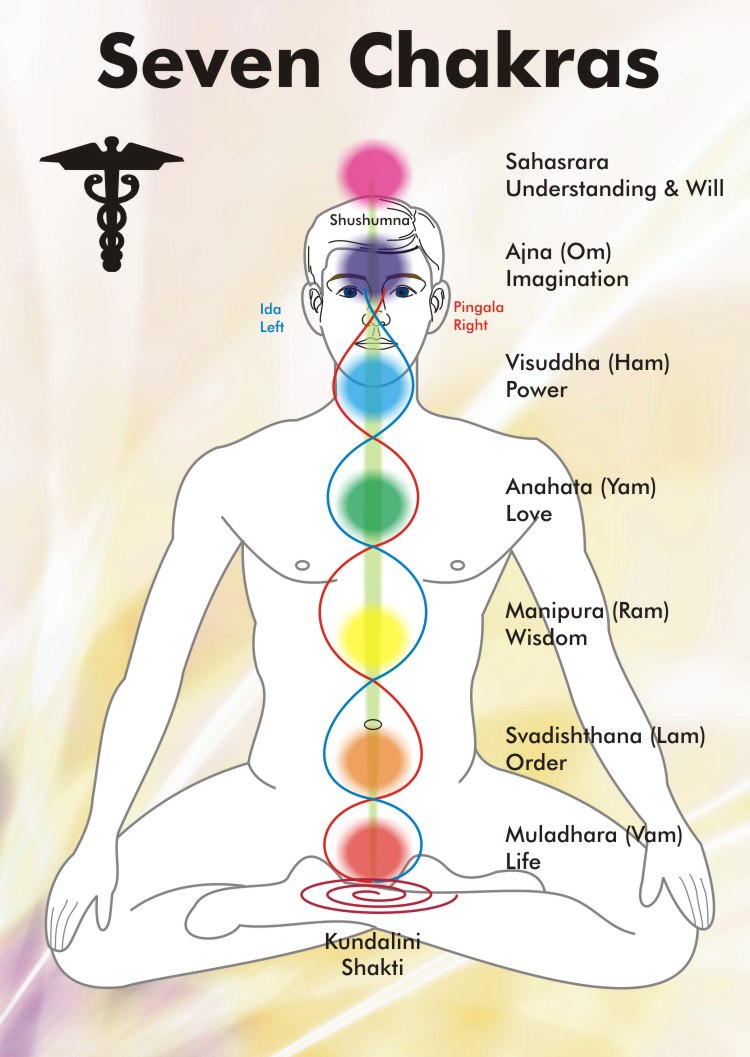
Maslow's hierarchy of needs and Yoga Chakras

A while back, I wrote how Darwin's theory of evolution seems to be codified within the ten avatars of Vishnu in Hindu scriptures long before Darwin was even born. The point was that we need to take a closer look at our respective ancient scriptures and texts with a more serious outlook without dismissing them outright as irrelevant.

Yesterday, I came across another instance where I think what the Western world had identified is something that has existed for ages - it's just that nobody bothered to take it seriously in modern times.

Maslow's hierarchy of needs

Case in point is Maslow's hierarchy of needs. I have come across the hierarchy a few times in popular science non-fiction books on psychology and brain function. Postulated by Abraham Maslow in 1943 after observing different types of people, it lists 5 types of human needs, stacked one atop the other. The theory is that one cannot move to the next level in the pyramid unless all the needs below it are satisfied. Here's a quick snapshot of the hierarchy.

For example, one does not worry about safety and morality when survival is at stake. Similarly love flourishes when one is secure. Finally, one tends to think about self-awareness only when the other needs are first taken care of.

Yoga Chakras
Maslow need not have wasted his time on research. The same concept, in an even more expanded form, is codified in the Hindu scriptures in the form of Yoga Chakras.

Chakras, as described in the Yoga Sutra (Sutra = Scripture) is embodiment of various forms of energy stored in a human body. The concept of chakra is mentioned in the Rig Veda, one of the most ancient Hindu scriptures, and were later made popular by the Sankhya philosophy (of which Buddhism has its roots). The scriptures state that a body needs to ensure that the energies are balanced at all times, failing which various forms of ailments (mental and physical) may arise. Channeling the energy properly (also described as channeling the 'chi' in Chinese spiritual texts) can help one attain enlightenment or freedom from this material world.

Now, how does this compare to Maslow's hierarchy? Let's first take a look at the chakras.

Each chakra is associated with certain qualities which represents the corresponding energies. They are
  1. Muladhara: Located at the end of the spinal cord, this deals with survival instinct.
  2. Svadhisthana: Located in the lower abdomen, this deals with feelings and sexuality.
  3. Manipura: Located near the stomach, this deals with self-power or basic intellect.
  4. Anahata: Located near the heart, this deals with love.
  5. Visuddha: Located near the throat, this deals with learning and expression.
  6. Anja: Located between the brows, this deals with self-awareness and insight.
  7. Sahasrara: Located at the top of the head, this deals with enlightenment or wisdom.
Looking at the two hierarchies side-by-side, you can see some amazing similarities:

Muladhara and Svadhisthana are related to Maslow's physiological needs.
Svadhisthana and Manipura are related to Maslow's Safety needs.
Anahata maps to Maslow's need for love and belonging.
Visuddha maps to Maslow's need for self-esteem.
Anja and to an extent Sahasrara maps to Maslow's self-actualization.

Unlike Maslow's needs, it does not stop there. Like most other aspects of Hindu literature, the chakra has multiple facets embodied in one simple codification. Here are two other facets to the chakra that are even more amazing.

Each of the chakras are located next to or are associated with a hormonal gland or organ in the body that has close correspondence to the activity described in the hierarchy.

Another explanation is that each chakra is associated with a light spectrum component, essentially spelling out the colors of the rainbow.

Apart from these, the chakra is also associated with a representation of the lotus flower, with each chakra having different number of petals. I am not sure what the numbers represent though, but am curious to find out. The overall chakra concept is also represented in the Kundalini form of yoga, which deals with channeling the energy through these chakras to achieve enlightenment.

I wonder how many other symbolisms are embedded in our ancient scriptures that we have since dismissed as heretic or irrelevant based on the bias and prejudice we have developed over the last few hundred years. I only hope that we have the sensibility to wipe the slate clean and look back with an open mind.

As the Zen philosopher Shinryu Suzuki said, "In a beginner's mind, there are many possibilities. In an expert's mind, there are few."